
Energy Systems With Heat and Cold
Energy systems with heating or cooling circuits are modeled in TOP-Energy with the heat transfer medium water. The material model water (MM_Water) is used here. The heat transfer medium can be changed by editing the material model or changing the material properties. The material model MM_Water is provided with two attributes that can be considered alternately: energy only and temperature dependent. For the specification of the temperatures described below, select temperature dependent. Only with this selection the mass and energy balances are set up and solved.

According to the principle of flow and return, complete circuits must always be modeled. There are no mass sources or sinks.
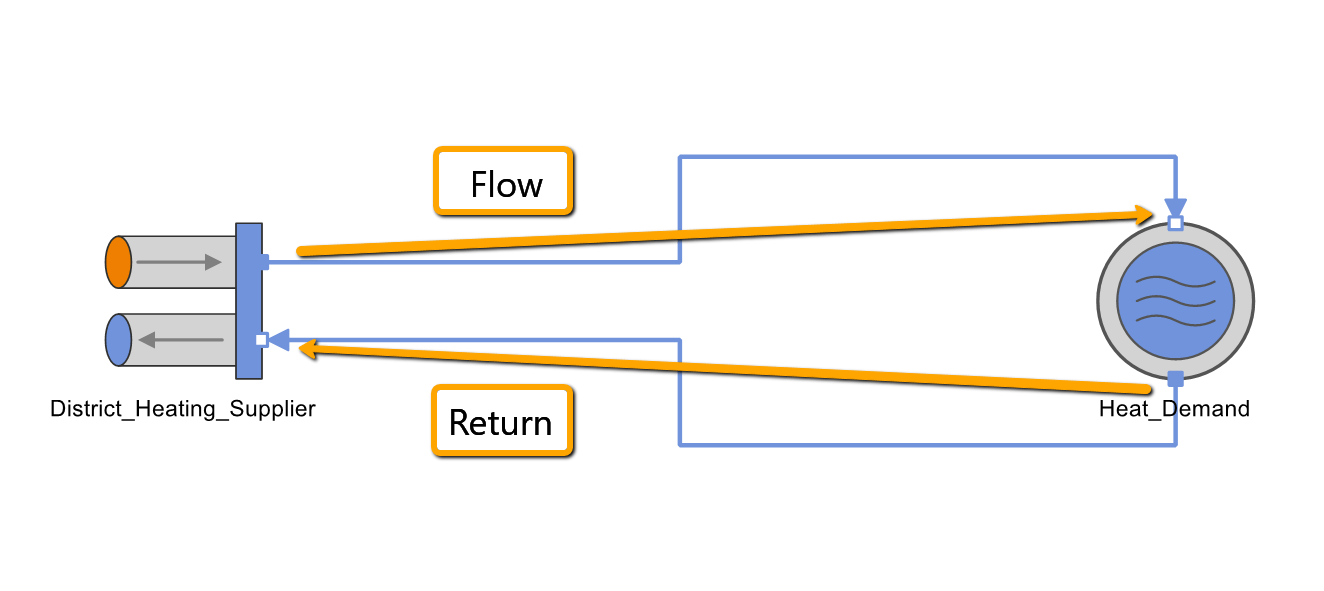
The heat transfer medium is characterized in each state by a defined energy, a defined temperature and a defined mass flow. The modeling principle is described in more detail below.
Setting the Temperatures
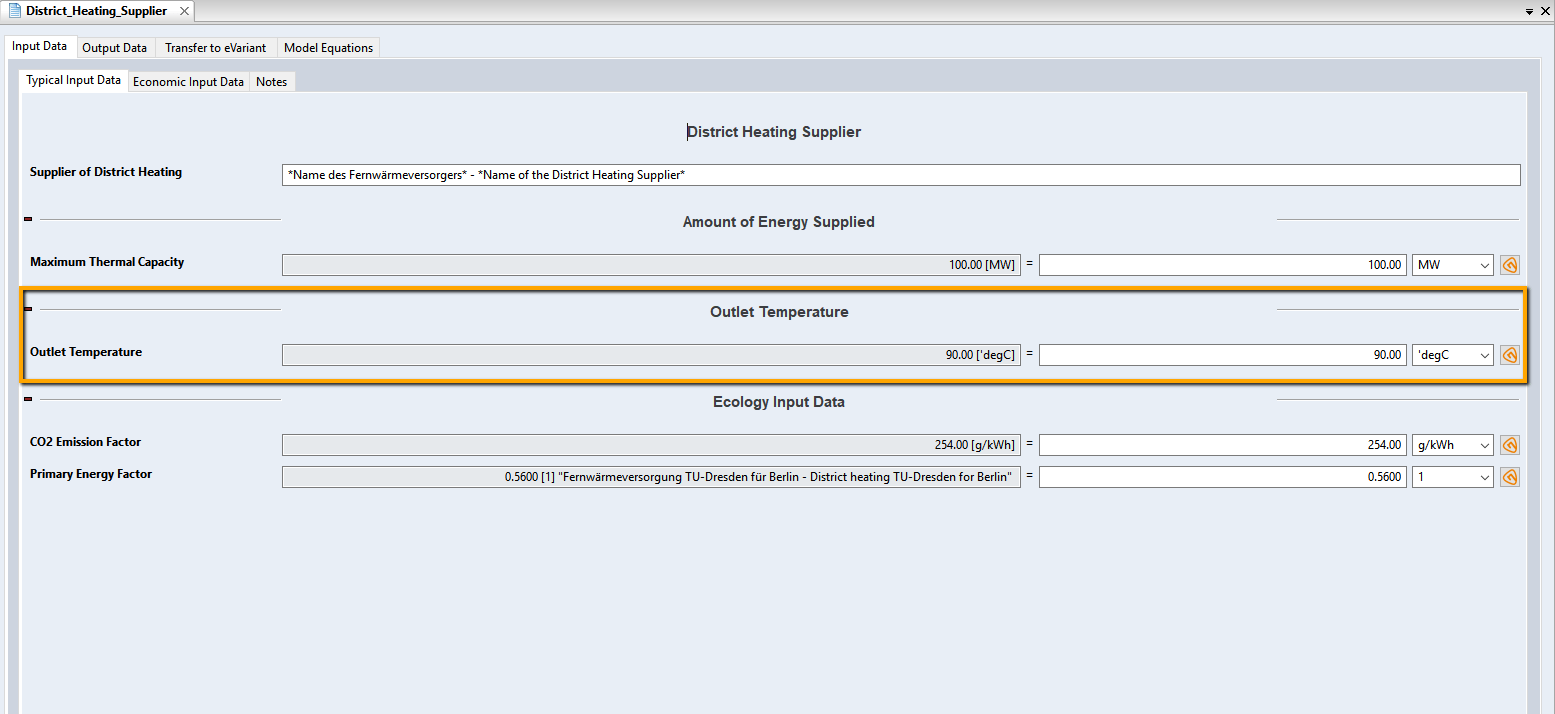
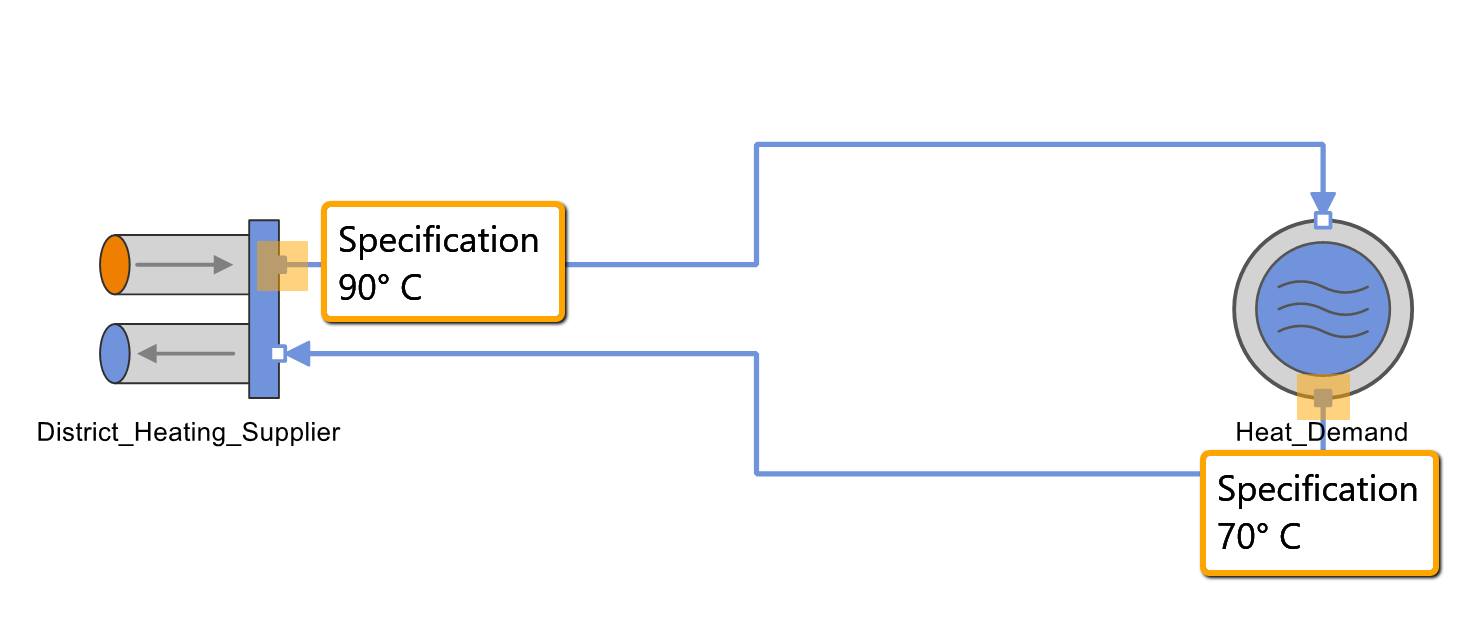
The temperatures of each heat circuit component (and similar to the refrigerant circuit component) must be specified as the outlet temperature in the form of the respective component. The default values are 90 °C (flow) and 70 °C (return) for heat and 12 °C return and 5 °C (or 7 °C) flow for cold.
The inlet temperatures and mass flows are calculated in the simulator and displayed in the output data of the component:
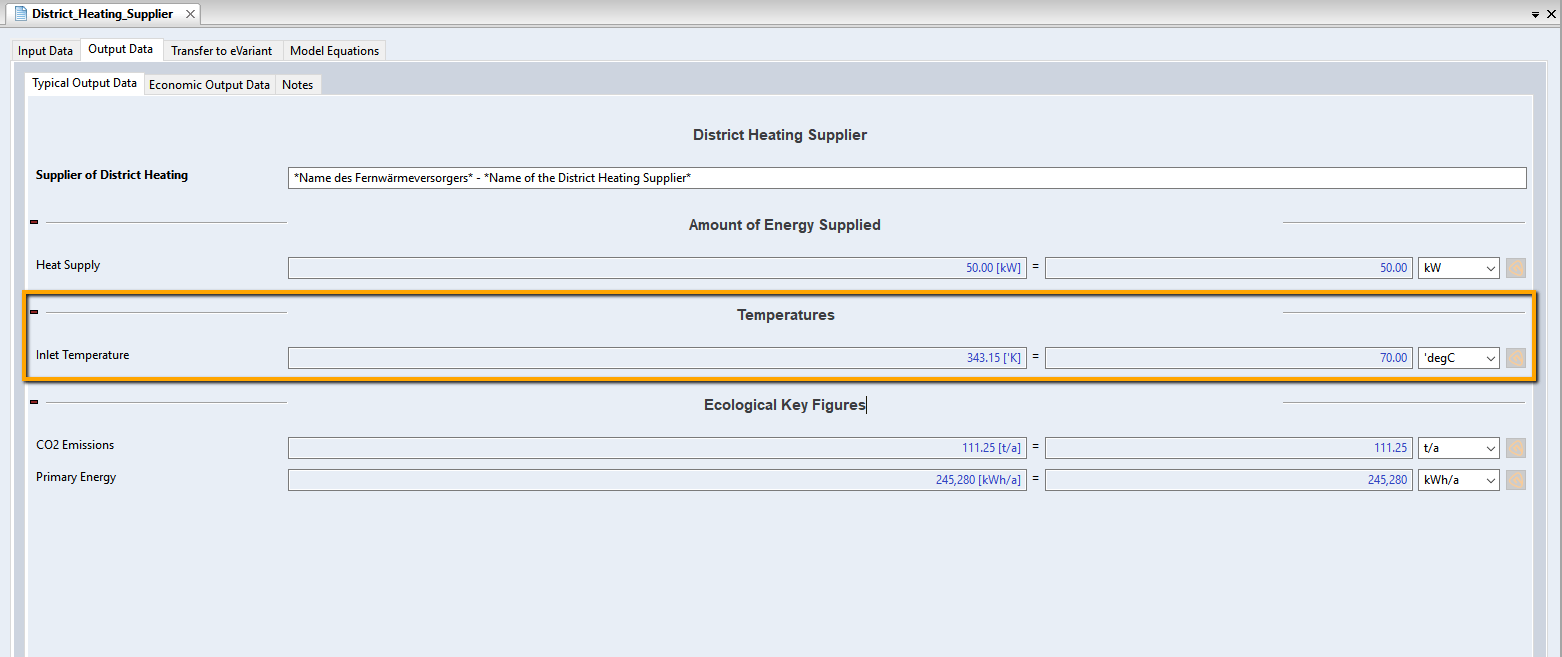
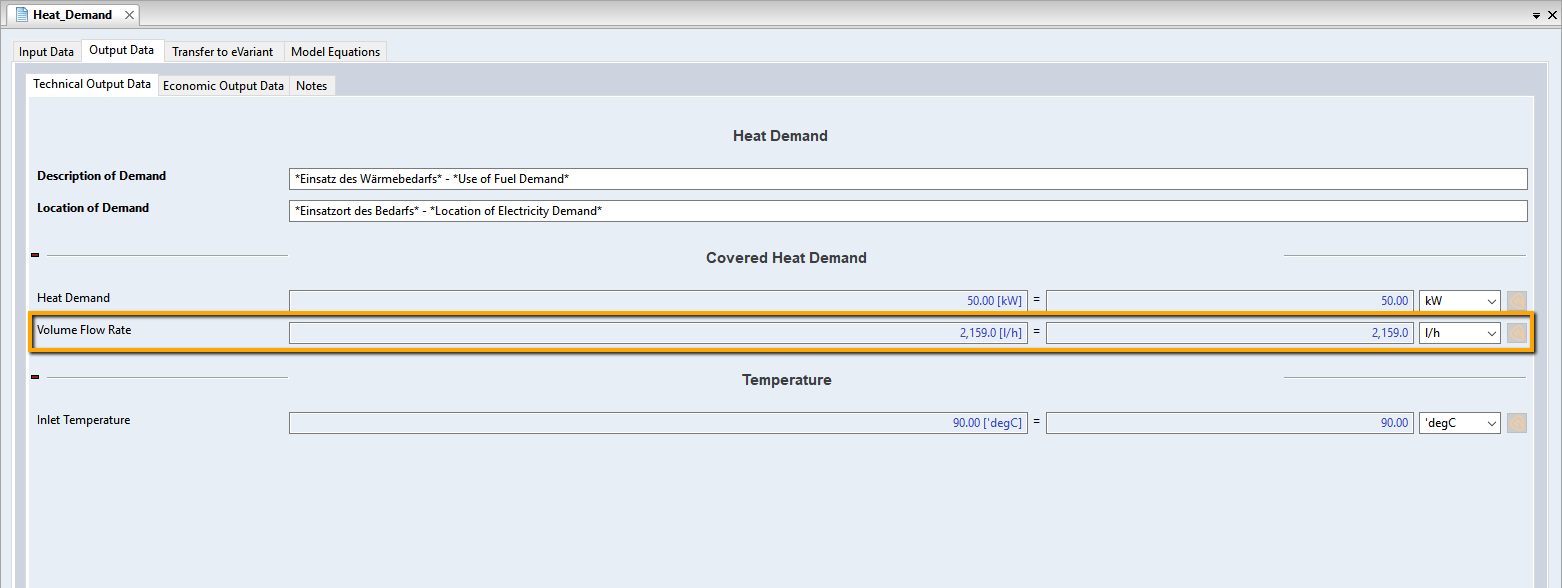
Only then can demands extract heat or cold from the medium and producers transfer heat or cold to the medium. The same applies to refrigeration generators:
The following error message indicates this in case of disregard:
Verify Input: The inlet temperature must exceed the outlet temperature. Please review the temperatures in ‘Technical Input Data’ in every component of the thermal cycle and verify the proper connection of supply and return flow.
Stream Mixing
For each mixture (and separation) of a material flow, an equation is established according to the principle of the ideal mixture, in which the excess enthalpies are neglected:
\(\dot{H}_{out} = \dot{H}_{in,1} + \dot{H}_{in,2} \)
The following figure shows how two material flows with different energy contents mix.
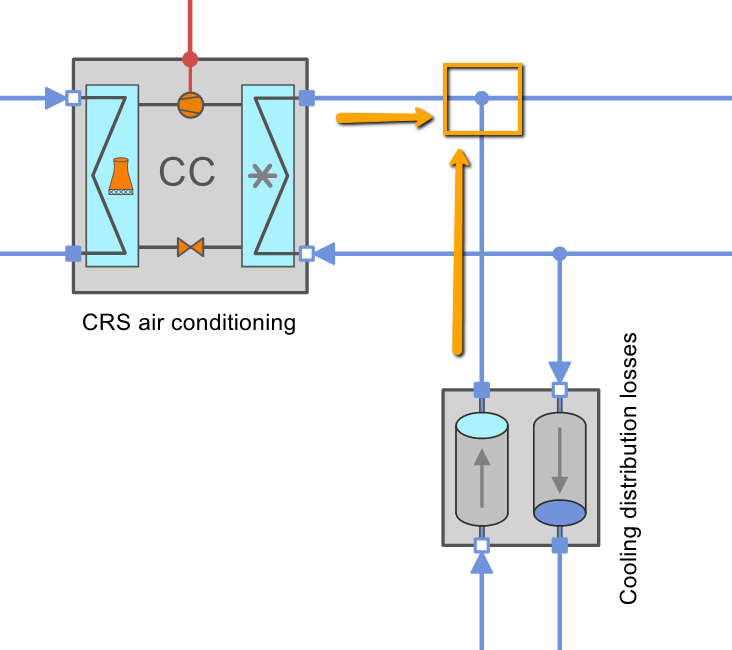
If there are degrees of freedom in the system, e.g., one demand and two producers, their mode of operation is optimized, e.g., to minimize operating costs. For modeling, this means that each producer must supply energy at a sufficient energy level to meet demand.
For example: In a system with a demand with a return temperature of 70 °C and two boilers, each boiler must have a flow temperature of at least 71 °C!
Advanced users can also use the method with Programmable Controls described in the separate article on Heat Generators at Different Temperature Levels.
Setting the Operating Mode
If there are degrees of freedom in the system, e.g., several generators between which the optimizer can choose, then an optimal operating mode is first calculated according to the Target Function defined in the Simulation form, by default the Cost of Operation. The principle is: The demands (e.g., Heat_Demand or Heat_Demand_Heating_Limit) are specified and the mode of operation of the generators (e.g., Hot_Water_Boiler, PowerToHeat, District_Heating_Supplier) is optimized.
If you want to specify how the producers operate, you have the following two options:
- An Availability component is dragged from the Component Templates folder Operational Side Conditions to the scheme. Then the same time series is specified for the Minimum and Maximum Power.
- Output data of the generator component are entered directly under Output Data → Heat Supply. The lock icon
 in the toolbar must be opened with a single click in order to
  Edit output data. Then a time series is entered there.
Mathematical Background of MILP Optimization
Within the framework of mixed-integer optimization (MILP), only linear (in sections) systems of equations can be treated. For the energy systems in TOP-Energy this means that the operation optimization takes place on the basis of an energetic consideration according to the 1st main theorem of thermodynamics. The most favorable form of energy generation is preferred according to the selected target function.
For heating and cooling systems, the cooling and heating capacities are optimized with the design variables \( \dot{Q}_{heat} \) and \( \dot{Q}_{cool} \). Subsequently, the nonlinear system of equations is solved, which contains the relationship between mass flow, specific enthalpy and temperature. This means that the following equations are solved at every point in the system.
\( \begin{equation} \begin{aligned} \dot{H}_{therm} &= \dot{m} \cdot \Delta h \\ &= \dot{m} \cdot c_p \cdot \Delta T \end{aligned}\end{equation}\)The temperatures are not yet known before the optimization and therefore cannot be the subject of the optimization.

