
Two Possible Procedures
With TOP-Energy, you can determine the optimal plant size for a new plant according to various criteria. Two different methods are available, depending on which energy system is involved and for how many plants the optimum size is to be determined.
Determination of Plant Size by Structural Optimization
The simplest way to optimize the plant size is the Structural Optimization. It is particularly useful when several systems need to be optimized simultaneously. Structural Optimization is described in detail in the article How Structural Optimization Works. The tutorial Structural Optimization of Combined Heat, Power, and Cooling demonstrates how to find the optimum plant sizes for an Absorption Refrigerating System and a CHP unit.
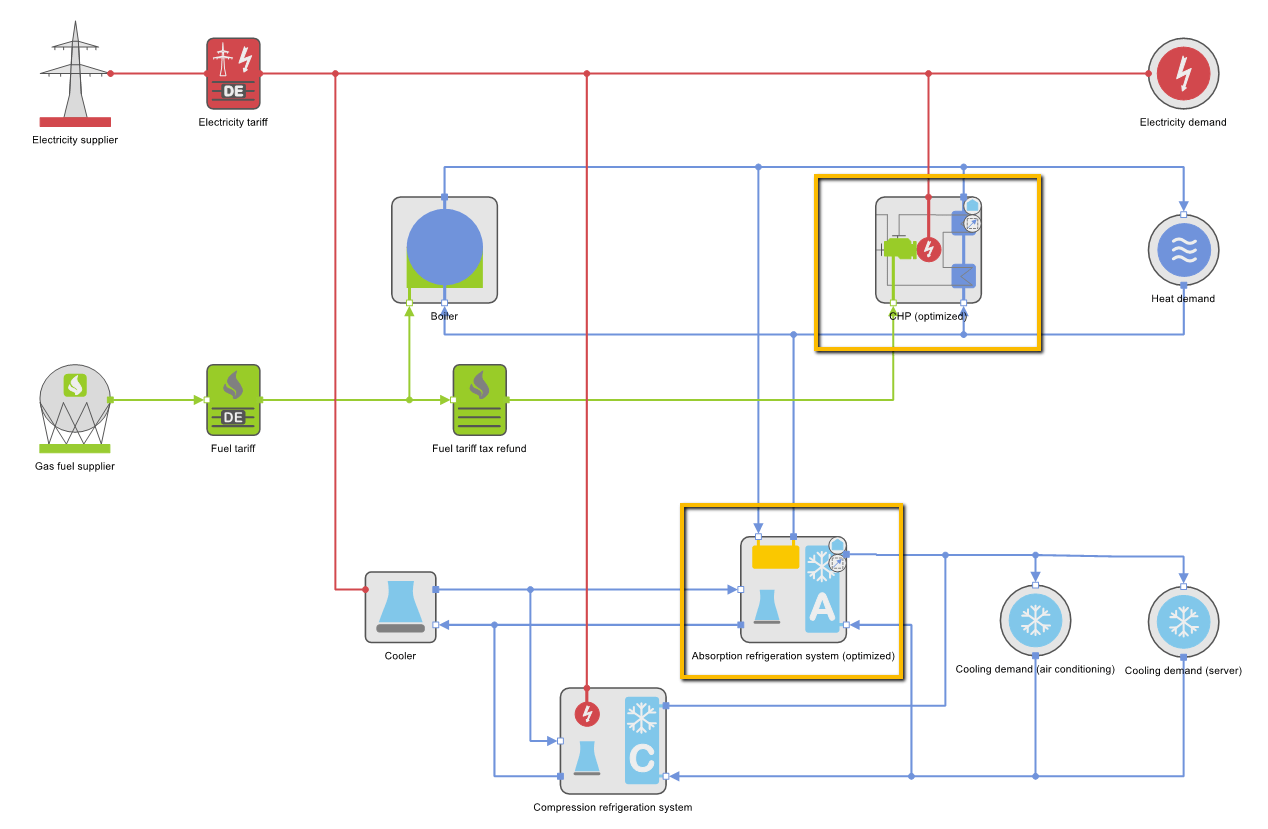
With structural optimization, parameterization of the partial load behavior is to be done via relative and not via absolute partial loads. The Electricity Tariff CHP Surcharge depends on the size of the plant and is therefore only available for structural optimization to a limited extent.
Determining the Plant Size Using Parameter Study
The Parameter study  can also be used to vary the nominal power of a plant or the capacity of a storage tank, searching a larger parameter space in the process. The Parameter study examines the dependence of the Sensitive Output variables on various Parameters and optionally on Additional coupled parameters. The sensitivity analysis carries out a Simulation with an Evaluation of Economical Efficiency for each interpolation point of the variable Parameters. As Sensitive Output variables, you can Select the target variables (primitives, e.g., Dynamic payback period, Overall primary energy, Internal rate of return). The result is the size of the plant depending on the Variable parameter. If this function has a minimum or a maximum, the optimum plant size is at this point.
The tutorial Structural Optimization of Combined Heat, Power, and Cooling shows the process. For example, the size of the CHP is optimized there. For this purpose, the Nominal electrical capacity is selected as a variable parameter. A Simulation, a Variant evaluation, and a Variant comparison are carried out for each size. The Net present value and the Dynamic payback period of the investment in the CHP are then evaluated. The input data are shown in the following figures.
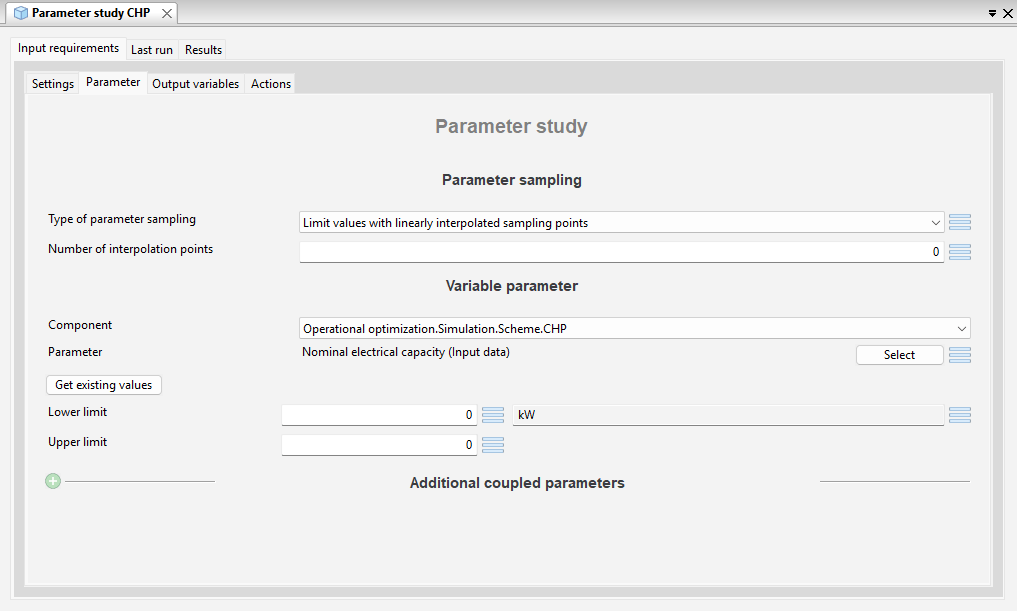
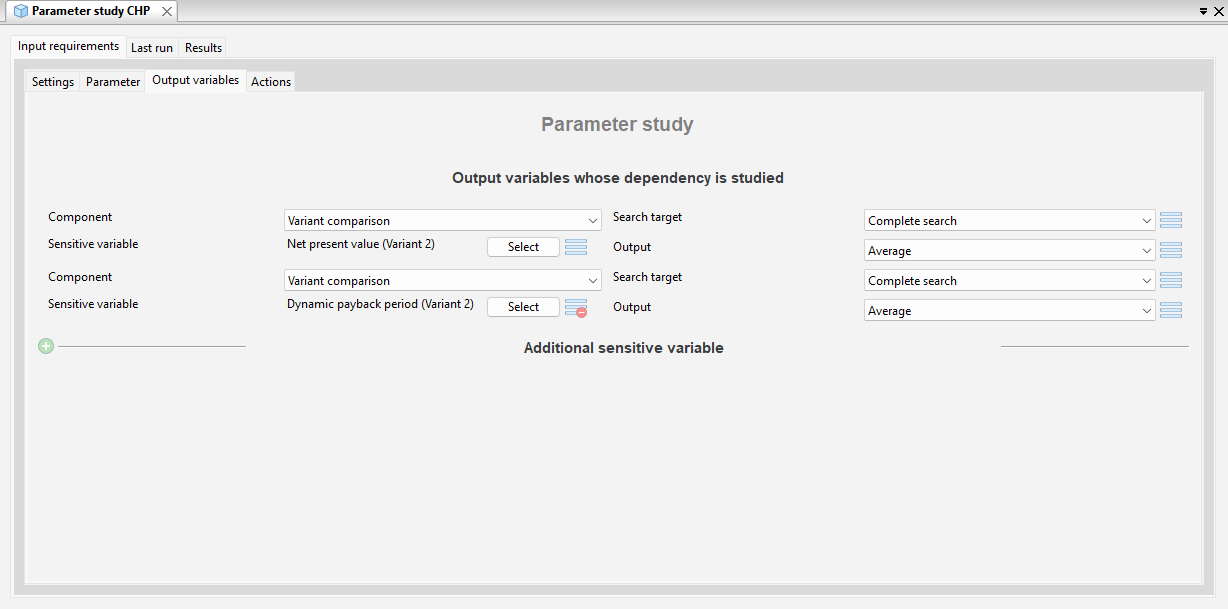
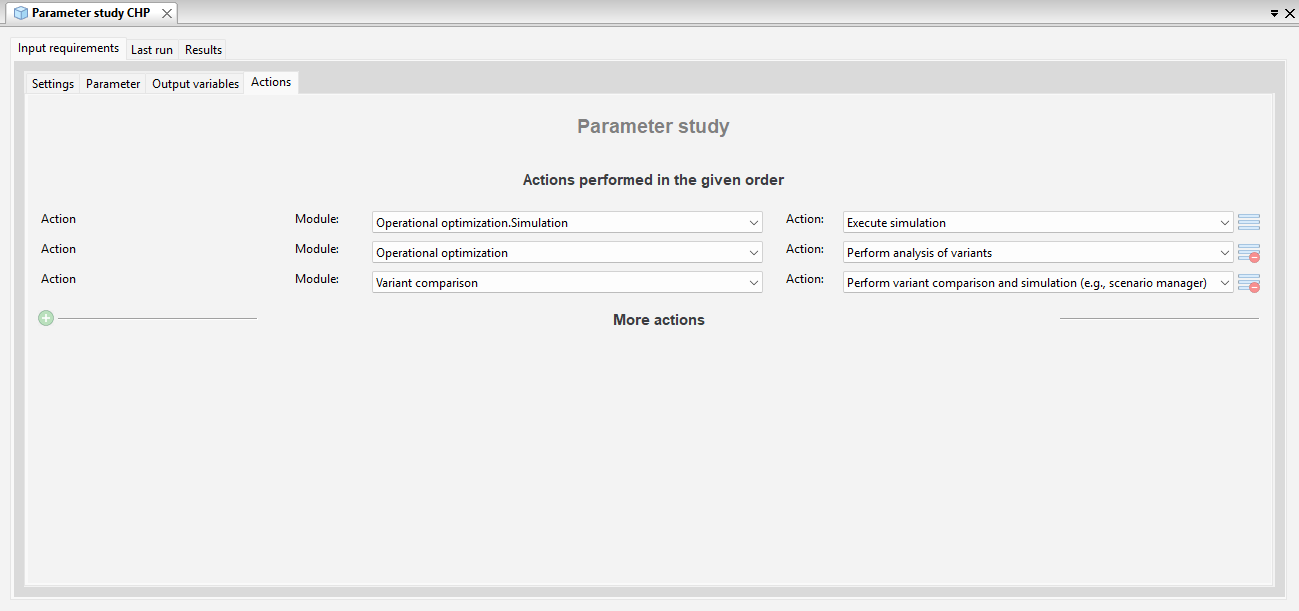
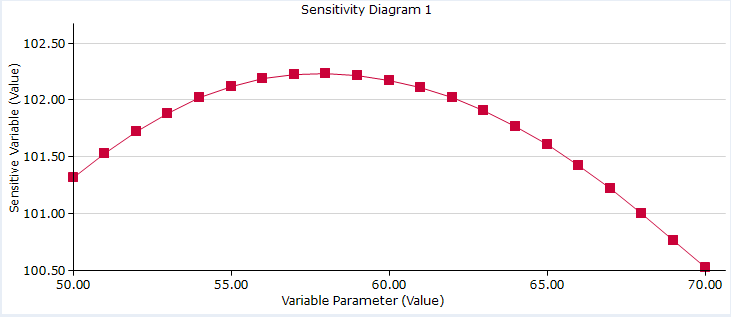
The following diagram shows the Net present value as a function of performance. The Net present value reaches its maximum at 59 kW in this example. Accordingly, a plant size of 59 kW is the best choice in relation to the net present value in this case.
Discrete Plant Sizes in Parameter Study
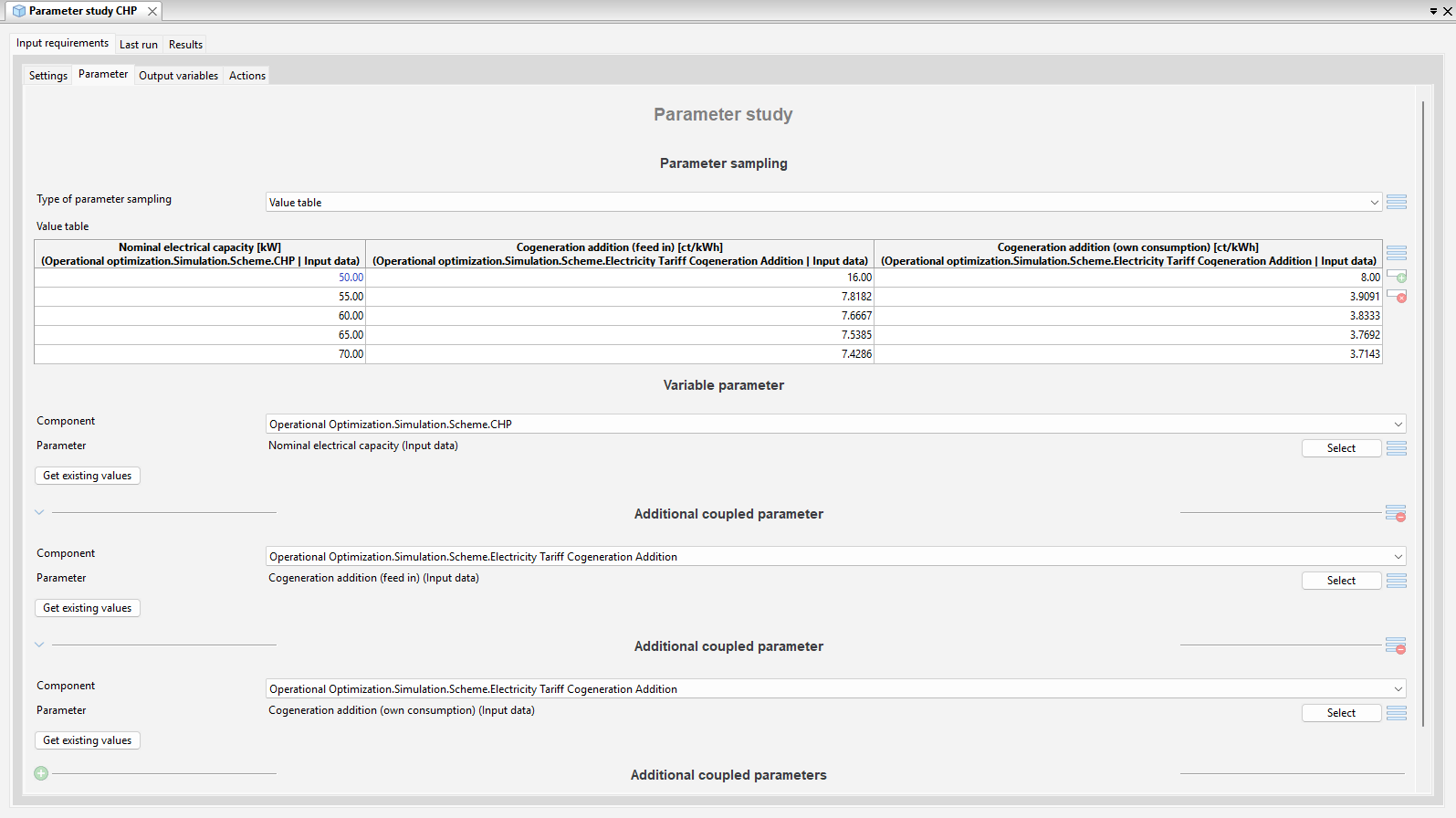
If the plant size in the analysis is to assume discrete values, you can specify discrete values in the Parameter study. Instead of scanning the solution space linearly, the values from the table are then used and evaluated. The selection is shown in the following screenshot.
Varying Other Nominal Capacities and Investment Costs
In the course of the variation of the leading Variable Parameter (e.g., Nominal electrical capacity), other parameters can also be varied in parallel. This is useful, for example, if the efficiency depends on the nominal capacity of the system. If, for example, the electrical efficiency increases with the size of the CHP, the Nominal electrical efficiency can be selected as Additional coupled parameter in the Parameter study.
Further parameters, such as Investment costs, can also be examined independently of the other parameters.

